Showing posts with label gender. Show all posts

Monday, October 20, 2008

like every day


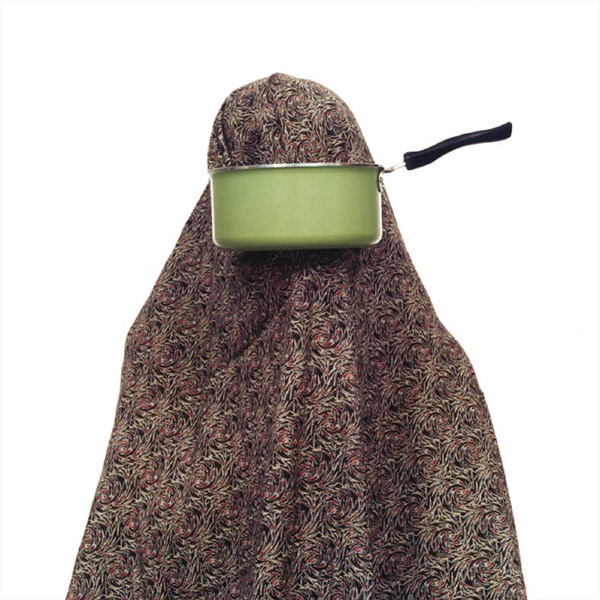
i was looking at some work by contemporary Iranian photographers and came across the project "Like Every Day," by Shadi Ghadirian. i really love these photographs. i think they balance political commentary with visual interest well, with a dash of surrealism and without being cloying. tall order.

and as a bonus, i really enjoy the reflection of Ghadirian in the top image's teapot as an additional mirror on muslim women and the subject in photography.

i also find her project statements refreshing. she says of her work:
"I am a woman and I live in Iran. I am a photographer and this is the only thing I know how to do. It does not make a difference to me what place the Iranian woman has in the world because I am sure no one knows much about it...

It was very natural that after marriage, vacuum cleaners and pots and pans find their way into my photographs; a woman with a different look, a woman who no matter in what part of the world she is living, still has these kinds of apprehensions. "
you can see more work by Shadi Ghadirian and other artists on the website of Houston's DeSantos Gallery.

Wednesday, October 1, 2008

aperture spotlight: women, in the photography


last night i went to the "Women in Photography" talk in Aperture's new Spotlight lecture series, hosted by the super Laurel Ptak. the talk was packed to the gills! i'd visited the Women in Photography website several times, so it was interesting to hear the perspective of the founders, Cara Phillips and Amy Elkins.

i knew the site was aimed at increasing visibility for female photographers working in the contemporary fine art mode, which is a lovely thing, especially if that's your passion. but i hadn't realized, until (the very well-prepared and well-spoken) Cara pulled out a powerpoint of statistics, how much the site's mission came out of a direct desire to remedy the fact that women face inequality as an identity category in the commercial art world--an inequality that they measured in major institutional credibility as well as dollars and cents. the discussion reminded me of many i've had among my white, middle class peers in, say, Women's Studies classes in college. especially when Cara offered the perspective that it was important for women to "learn to be powerful" and that if one believes in good things like equal pay, then it makes sense to identify as a feminist.  but, you know, i think these things just feel more complicated for some people.

i think i am in a privileged position to not want to measure success by the number of solo shows women have had at MoMA last year (1 out of 18) or the number of women among the top grossing artists. i do not dispute that these facts are real and that they really affect people. however, i'm mainly interested in work that is successfully provocative and discourse-inducing. even if it is less popular, more difficult to track down, or made by people without genders. but hey, if i were out there trying to pitch myself to Gagosian right now, i might be feeling a lot more like Cara and Amy.

Amy quoted Imogen Cunningham, who, when asked how being a woman had affected her life as a photographer, replied "I'm a photographer, not a woman." i couldn't tell Amy's intention in conveying the quote, or whether she felt critically that it reflected a sad necessity of Cunningham's era. (interestingly, Diane Arbus had a similar, but maybe less revolutionary, twist on this: "Look, I'm a photographer, not a woman photographer.") personally, i find Cunningham's remarks fascinating at face value--but don't feel a stake in prioritizing or analyzing her identifications. but i imagine that for many of the photographers featured on Women in Photography, being a woman is primary among their personal identity politics.

the discussion also reminded me that i should push harder in my own quest to seek out interesting, diverse work to think about and talk about, and not just pick through the obvious links. (once again, these events make me feel like the internet can sometimes make itself a small place.) it also made me realize that focusing on portraits on Subjectify has seemed to mean that i single out female-identified photographers more often than not. i definitely wonder why that is--and whether my eye, my identity, or an affinity for portraiture might be a cause.

overall, i was very happy to hear personal stories from panel photographers Elinor Carucci and Robin Schwartz, and to see previews of more of their new work. (i had seen Carucci's work a lot and had questions about how female beauty, nudity, and confessionalism factored in. so it meant a lot to hear about the work from her perspective--and i especially enjoyed her thoughts on the erotic tension of family relationships. one of her photos, "My Mother and I, 2000," is featured above.)

i deeply appreciate all of the panelists for their honesty, humor, and willingness to share.

(and tonight Justine Kurland was presenting at Aperture but i got sick and couldn't make it. YouTube, anyone?)

Wednesday, July 9, 2008

three questions for carmen winant, part 1


shortly after i first saw Carmen Winant's portraits featured on Conscientious, i got an email from her out of the blue. she had just started a new process of engagement, if you will, pledging to post a photo online every day for a year at daily afterthought--and she wanted to talk blogs.

although i liked many photos in the portfolio that Jörg had linked to, they didn't suck me in as complete projects. it was Carmen's written voice that compelled me, and the single, out-of-context images that she was posting up each day at daily afterthought that reeled me in. (i mean, how many people have a fresh and good new portrait every day? even dipping into their archives?) though she's still playing with different approaches and themes, Carmen has a pretty consistent vision. her best photographs, to my eye, are unexpectedly sensual and deeply emotionally engaged. consider me seduced.

i'm pleased this week to offer three brief questions / discussions with this emerging photographer about her work and her confrontation of the subject.

Subjectify: In many of your portraits I feel that your compositional eye has a way of closing in on, or immobilizing the body. As objects, the bodies are posed, perhaps, but particular, imperfect and unsentimental. Are there specific things you are trying to express in your work about bodies and their relation to spaces?

Carmen Winant: My photographs have always been concerned with the body. Before I began photographing, I was a very technical illustrator, and all my illustrations also took on the body exclusively. I was a competitive distance runner from age 15 – I ran track and cross-country for UCLA – which I think informed my fascination with the physicality of the body. And then, as I became a feminist and concerned with debates around identity politics, I became open to seeing the body’s potential in art to manifest critical gender issues.

I am of course always thinking about the body’s relationship to context and space. But beyond that, I am interested in the body’s relationship to the absence, or denial, of space. This is most overt in my ongoing series Dark Matters, in which the space becomes a reductive, recessed vacuum. I was attempting to make a series of pictures that were both classical and radical by oversaturating and overexposing to the point of total darkness. Usually I go too far, and the negatives are often way too thin to use.

In addition to removing referents, I tend to narrow in pretty tightly on the bodies of my subjects. In fact, I was repeatedly asked in UCLA critiques why I didn’t just back up already and give the viewer some space to breathe. I think this is really evident in the series Close. And thinking about it now, it’s telling that I chose to shoot environmental portraits (the At Home project) in cramped New York City apartments, that wouldn’t afford me the space if I wanted it. So, the spatial confinement is always a component. It can feel a little claustrophobic, so I try to be careful about not overloading my images with information. If an image is successful, the body will serve as the only punctum.

Finally, I tend to photograph my subjects’ backs quite a lot. My mom has a theory that my preoccupation is due to my own medical diagnosis at age 17 of severe osteopenia, which requires me to get my spine density tested and monitored with some regularity. I like to think that it is another (more deliberate) method of drawing in the viewer with an intimacy that is very carefully and tentatively measured. A turned back can represent several conflicted signals of bodily power. It clearly indicates a loss of control for the sitter, who is perhaps being looked upon without their knowledge. Yet a turned back is also a refusal; ultimately, the onlooker is the one being denied or powerless. Also, I am interested in the notion that the audience enters subjecthood through a turned back, as in, we can only be absorbed into the subject through the back of their head. I feel that all successful and complicated portraits have to have this element of emotional incongruity.

Friday, June 20, 2008

subject echo: hair in branches


lately i have noticed a lot of ladies with their hair tied up in branches. it makes for pretty, romantic images. and perhaps it makes for thinking about girls, gender and long hair, nature, ties, and other metaphorical tangles. but what is it all about?

Julia Fuller-Batten's work (above, middle) is all about adolescent girls, so it would make sense to me if Hellen van Meene (top) were an influence. and Steffanie Halley, recently featured on Conscientious, is a recent SCAD grad whose project places women in the natural landscape... another theme we've seen a lot of lately.

my personal instinct would be that the bottom two are echoes—conscious or subconscious—that serve as aftershocks to the power of van Meene's image.

however, one commenter on Shoot! said that the second image above is a "direct reference" to Harry Callahan. is this true? if so, he would have set the trend off then, maybe even 50 years ago. but i am skeptical. i've seen Eleanor's hair, spreading out wet and stringlike. i've seen Eleanor's face, superimposed over grasses and branches. but i don't know an image of Eleanor's hair tied up into branches.

anyone care to school me? (or the commenter?) or share any other thoughts on this theme?


p.s. reader Suzanne's comment (below) is so right on—i definitely think that Sally Mann's "Yard Eggs" is another major influence here. the composition (and symbolism) is a little more complex than the three above, but the hair getting caught in the branches is definitely a punctum. it made me realize i've seen this image online, but not sure i have seen a print of it. the resolution of the jpeg is a bit soft, and i would love to see the detail better, especially in how the hair is caught (and not just blowing). thanks Suzanne!

Saturday, May 31, 2008

full text of jessie mann's interview


someone sent me a reminder that i had promised to upload a full text version of the Jessie Mann interview that ran here last week. (you people are freaks. freaks! i love it.)

seriously, for the unexpurgated interview (all 8,192 words, including an additional bonus question), you can now view and download it as a Google Document here.

and here are the individual blog posts that make up the interview, with photographs:

Friday, May 23, 2008

jessie mann interview, part 5


part five of Seven Questions for Jessie Mann. the gay part.

Subjectify: Self Possessed definitely tackles ideas of gender and performance, and the subject or muse as a feminine archetype. Do you subvert that dynamic in your role as the conscious subject? The characters you portray in Self Possessed include Mapplethorpe and Warhol. I imagine that their queerness helped them disrupt the traditional barrier between subject and artist in their work. How does that function in your project ? Does Len Prince’s sexuality, or yours, have an impact on your work together to question the role of the subject?

Jessie Mann: This one is my favorite question! I like your use of the word queer—it is my favorite for such discussions, and so I will stick with it. For ease, I will once again break this question down into two broad topics: the first, being the idea of gender and its relationship to the subject in art and culture. The second being the role of sexuality in this collaborative project and others. To start, I do try to subvert a few ideas. One of them being that women in art are silent objects. Another, that women in collaborations were inevitably exploited or in someway manipulated into acts of self exposure. And still another, the idea that it is women who have exclusively populated the role of muse and/or artistic object. By speaking about my role, from my position, I am able to at least assert that one woman was not silent—is not silent, was not exploited, will not be exploited. That it is possible for the muse or the subject to bring artistic action to a collaboration. I try to get people to question the assumptions we make about women in art, and the subject in general. I am often asked why I didn’t “just take self portraits?” But a very important part of this project is to assert that the act of collaborating with the artist is artistic, that what women have been doing for so long, is “enough”—I don’t have to take the pictures myself; I can even pose nude for a man (gasp) and it can still be me making art. Additionally, by portraying Warhol, Dali, Mapplethorpe, and Beuys I am reminding people that the use of the self, the body, and one’s character in art is not something reserved for women, while at the same time giving a nod to the fellows that gave me the precedence to take on this theme.

It seems to me that both queers and women are particularly appreciative of the distinction between self and character. Here I would reference Wilde as a prime example of this self aware posing that is widely practiced by queers and perfected by the all-too-rare brave woman. Why this talent is most frequently, or even exclusively, developed by queers and women, is perhaps another chicken or egg question. Do women and queers feel the social need to separate identity from character, is the external flamboyance assigned to women and adopted by queers a result of social roles/pressures or is a certain amount of flair and show simply a part of the wonderful nature of said human beings? This is maybe another question I don’t really have the answer for, but I do love the discussion.

And though the overlap between queer culture and the cultural identities of women is infinitely interesting to me, I would like to take this opportunity to turn the question around. Why don’t straight men make characters of themselves? Why is it that queers and women share this trait but straight men don’t? Is it that they think of themselves or are seen as the fallback position—no need to define yourself when you are vanilla—everyone else has to add flavor, or is the straight male identity lacking in character? A notable exception to the rule that ‘the straight man’ doesn’t make a character of himself are writers. Hemmingway, Hunter S. Thompson, and Phillip Roth with his alter ego Zimmerman, all made characters of themselves as much as they wrote new ones into existence. Perhaps, something of it has to do with the position of the observer. From that stance, the outside, the viewer develops a sense of the play of it all. Or, maybe, the artistic spirit can, in fact, be channeled into ‘character making’ as a medium, and ‘outsiders’ simply tend to make good artists.

Finally, on the point of sexuality—I think it is relevant to this project that Len and Jason Paulson, who did a majority of the make up and styling on these photographs, are partners. I think that is a cog in the dynamics of this project that people are not generally aware of when they are introduced to this work. One blogger, reviewing the work, wrote that it was just another example of the dirty old man looking at the young girl posing. Just more of the male gaze. I found this hilarious. Definitely not for the first time, but maybe for the first time since people have been allowed to be open about their sexuality, we have been openly documenting an archetypal love—the queen for the queer and vice versa. I wonder how many collaborations of this kind have gone down to history in silence. The sexual dynamics of our team also allows the character I make of myself freedom from just that male gaze. In might be that the absence of a sexualized air, a familial environment (if you will) allows me to fully integrate my character as a woman—self possessed—sexual yet not objectified—a character—yet one who writes her own dialog. When I asked Len about this question, he said that gay men get this work better; they are looking for the nuances of meaning in a dialog that uses their language, in short, they are not distracted by the tits. I don’t know if that is really true, but there is so much of this work that speaks to queer identity and the many suits (of armor perhaps) that women wear. Someone once said that Monroe flirted with the camera, Len and I might just be pulling a ‘deadpan camp’ right back at the camera— itself known for its pregnant silences and contrived blankness.

Thursday, April 10, 2008

subject echo: michal chelbin and alec soth


when i was looking through Michal Chelbin's portfolio earlier in the week, the top image, called "Janna and Alona, Russia, 2003," caught my eye. it made me think of Alec Soth's photo "Mother and Daughter, Davenport, Iowa 2002."

both reminded me that i have seen a lot of photographers lately whose work is described as following "in the tradition of Diane Arbus and August Sander." and i realized that i have seen frequent comparisons to Arbus for Chelbin and Sander for Soth (perhaps gender lines have something to do with this, as well as Chelbin's focus on circus people and other "strange" folks). yet to me, Arbus and Sander are very different (you could even say that Sander's universalizing eye was critiqued by Arbus's more minoritizing one...)

here, both Chelbin and Soth are exploring the idea of ethnography in their respective projects "Strangely Familiar" and "Sleeping By the Mississippi." what does it mean to go out with your camera and try to capture a people or a place (or the spirit of one in the other)?

so, just a sketch of an idea here... but back to the photos themselves — they have the echo of the legs and a similar bit of a louche air in the mood. Janna and Alona are Eastern European child circus performers, and the Mother and Daughter are in a brothel along the Mississippi in Davenport.

both might seem exotic to the viewer, but it's just everyday life for the subjects, and if nothing else, you could say both are "strangely familiar"...

Thursday, March 13, 2008

transgression, hunter, tilda


i flipped through the latest issue of OUT Magazine today at my office, and i was pretty impressed by the photographs—which i guess i don't usually pay too much attention to in OUT or similar mags. i don't know if it was the fact that it was a gender-transgression themed issue that gave the portraiture that extra frisson... but with David Armstrong shooting Tilda Swinton, Ryan Pfluger shooting an article on trans fags ("Hunter" above, top), and Cass Bird doing her take on the fashion spread, you can't go wrong. three great photographers!

i'd seen some of Ryan Pfluger's personal projects, and i think i enjoy his editorial work just as much. he also has a blog.

and i have such a crush on Cass Bird. inexplicably, you can see her do a Michael Jackson dance routine here.

p.s. in the OUT interview with Tilda Swinton, she mentions being up all night shooting with Nan Goldin. and the accompanying photographs are by Goldin's longtime collaborator David Armstrong. strange, right? any Goldin photos of Tilda out there?

Thursday, February 28, 2008

national parks (and other topics)


Manya Fox is another photographer that i checked out through Humble Arts' competition 31 under 31.

an aside: honestly, i'm a bit torn about 31 under 31 because...well, what are women? and what does it mean to be under 31? what's so great about privileging categorization based on gender and youth?

should i support it as a form of affirmative action? let's see: it's an online competition (with a corresponding exhibition at an independent Brooklyn gallery ). have young women been otherwise shut out of the online discourse in fine art photography? i'm going to go out on a limb and say no. (not to say that women are not disadvantaged in commercial photography or in the art/gallery world in other ways.)

on the flipside, i am learning about exciting new work by emerging photographers i might not have checked out otherwise. and so are you. i think this is really great! but i've still got to say that i'd like to see more creative competition criteria. (for those tracking the identity politics: i'm a photo-taking female under 31.)

but i digress. Manya Fox! her photos glow right off my screen! her series "National Parks" is an effective mix of landscapes and environmental portraiture. they have a particular quality and palette that i can't quite put my descriptive finger on (southwesternness?), but it is distinctive nonetheless.

i liked these two photos, so i picked them (not sure why i went for the two with children). here's more. i wish the jpegs were higher resolution though; something about the resolution looks a little off/fuzzy to me.

Monday, January 14, 2008

double life and the space between


i'm sure it comes as no surprise that i love love love the work of Kelli Connell. Connell scans and combines multiple (medium format) images of the same model in Photoshop to show moments in the relationship between two people. to me, the resulting images feel like short stories. the fact that both characters are played by the same model make them instantly recognizable as fiction (a fiction that feels very true to life), and makes reading the interactions between the characters that much more interesting. the constructed realities they present offer the viewer many questions...

Connell describes her ongoing project as "an autobiographical questioning of sexuality and gender roles that shape the identity of the self in intimate relationships. Polarities such as the masculine and feminine psyche, the irrational and rational self, the exterior and interior self, and the motivated and resigned self are portrayed." all this talk of polarities and the self makes me think of the Jungian archetype of The Syzygy: two entities, masculine and feminine, combined to form an archetypal whole without losing their own identities. Connell's couples portray the paradox of this idea of subjecitivity so vividly.

one thing i find fascinating about her work is how frequently people assume that the model is Connell herself (she isn't--i'm not sure who the model is, but she's pretty amazing). i made the same mistake when i first saw them. i wonder, would that assumption happen to any photographer who exclusively photographed one person...or is it something particular to the intimacy or the visible queerness of the project ? (or something else?) obviously her work raises a lot of questions and challenges assumptions. as she says, "I am interested in not only what the subject matter says about myself, but also what the viewers response to these images says about their own identities and social constructs."

Kelli Connell's monograph is called Double Life. the images above are "The Space Between," "Pregnancy Test," and "Reverie."